
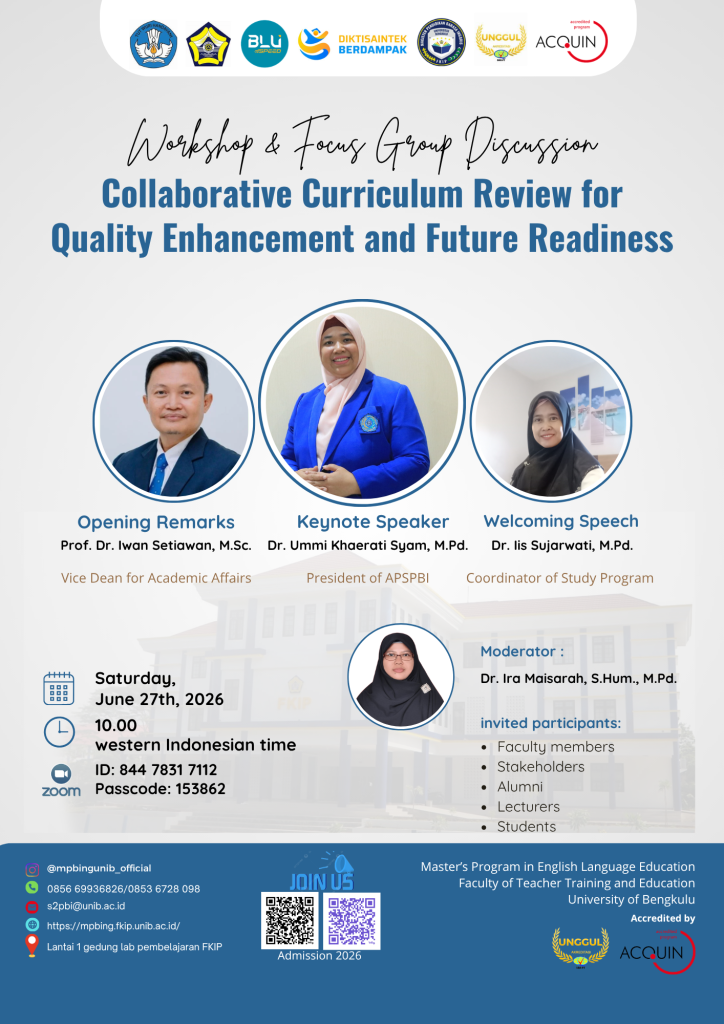
Bengkulu, June 27, 2026 – The Master’s Program in English Language Education (MPBIng), Faculty of Teacher Training and Education, University of Bengkulu, successfully conducted a Workshop and Focus Group Discussion (FGD) entitled “Collaborative Curriculum Review for Quality Enhancement and Future Readiness.” The event served as a strategic forum for reviewing and revising the 2026 curriculum to ensure its relevance to current educational developments, stakeholder expectations, and future workforce demands.
The workshop was conducted in a highly dynamic, interactive, and comprehensive atmosphere, bringing together academic leaders, faculty members, students, alumni, practitioners, and external stakeholders. The curriculum review was designed not merely as an internal academic exercise but as a collaborative effort to ensure that the revised curriculum genuinely reflects the needs of the profession and the rapidly evolving landscape of English language education.
The keynote address was delivered by Dr. Ummi Khderati Syam, M.Pd., President of the Indonesian Association of English Language Education Study Programs (APSPBI). In her presentation, she highlighted current national and global trends in English language education, emphasizing the importance of designing an outcome-based curriculum that is adaptive, innovative, research-oriented, and responsive to technological advancements and societal needs. The workshop was officially opened by Prof. Dr. Iwan Setiawan, M.Sc., Vice Dean for Academic Affairs, who reaffirmed the faculty’s commitment to continuously improving academic quality through systematic curriculum evaluation and evidence-based revision.
In her welcoming remarks, Dr. Iis Sujarwati, M.Pd., Coordinator of the Master’s Program in English Language Education, highlighted that the curriculum review represents the program’s commitment to continuous quality improvement through collaborative governance. She remarked,
“This curriculum review is not merely an academic requirement; it is a strategic initiative to ensure that our curriculum remains relevant, responsive, and aligned with the evolving needs of English language education. The active involvement of faculty members, students, alumni, practitioners, and stakeholders is essential to developing a curriculum that prepares graduates for future educational challenges and global competitiveness.”
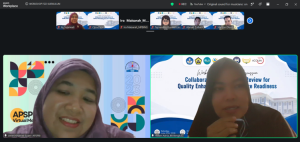
She also expressed her appreciation to the keynote speaker, university leaders, faculty members, alumni, students, and stakeholders whose insights and experiences would play a vital role in developing a curriculum that is both academically rigorous and professionally relevant.
In addition to Prof. Dr. Iwan Setiawan, M.Sc., Vice Dean for Academic Affairs, the workshop was also attended by Dr. Dian Pujianto, M.Or., Vice Dean for Finance and General Affairs, faculty members, students, alumni, and invited stakeholders. Their active participation demonstrated a shared commitment to ensuring that the curriculum revision process is comprehensive, evidence-based, and responsive to the needs of higher education and the professional community.
One of the highlights of the workshop was the interactive Focus Group Discussion, during which students, alumni, and stakeholders were given extensive opportunities to ask questions, provide constructive feedback, and share their perspectives on the competencies expected of future graduates. The discussions were lively and insightful, allowing participants to critically examine the existing curriculum and propose recommendations for improvement. This collaborative approach ensured that the revised curriculum would be firmly aligned with the findings of the program’s comprehensive needs analysis and the expectations of its diverse stakeholders.
The workshop welcomed stakeholders from various educational institutions and professional organizations, representing schools, higher education institutions, government agencies, and private educational organizations. Among the distinguished participants were representatives from SMP Negeri 8 Kaur, the Language Office (Balai Bahasa) of Bengkulu Province, MJ Education Center, Lubuk Linggau, South Sumatra, and the Vice Rector IV of Dehasen University, Bengkulu, representing the higher education sector. Their diverse expertise enriched the discussions by providing valuable insights into current educational practices, institutional expectations, and workforce needs. Their contributions were instrumental in ensuring that the revised curriculum remains relevant, responsive, and aligned with both national educational priorities and the evolving demands of the English language education profession.
Throughout the discussion, participants emphasized the importance of strengthening graduates’ competencies in research, digital pedagogy, English language teaching innovation, curriculum development, academic publication, leadership, and educational entrepreneurship. The recommendations generated during the workshop will serve as important evidence for refining the curriculum and ensuring that it effectively prepares graduates to address contemporary challenges while remaining adaptable to future developments in English language education.
The workshop concluded with a shared commitment among all participants to develop a curriculum that is academically rigorous, professionally relevant, and internationally competitive. The recommendations and insights gathered throughout the workshop will become an integral part of the 2026 curriculum revision process as the Master’s Program in English Language Education continues its commitment to producing graduates who are innovative educators, competent researchers, and future-ready professionals.
Through this collaborative initiative, MPBIng reaffirms its commitment to continuous quality enhancement through meaningful stakeholder engagement. By integrating the perspectives of academic leaders, faculty members, students, alumni, practitioners, and institutional partners, the program continues to strengthen its curriculum to meet national standards while responding proactively to global developments in English language education.