
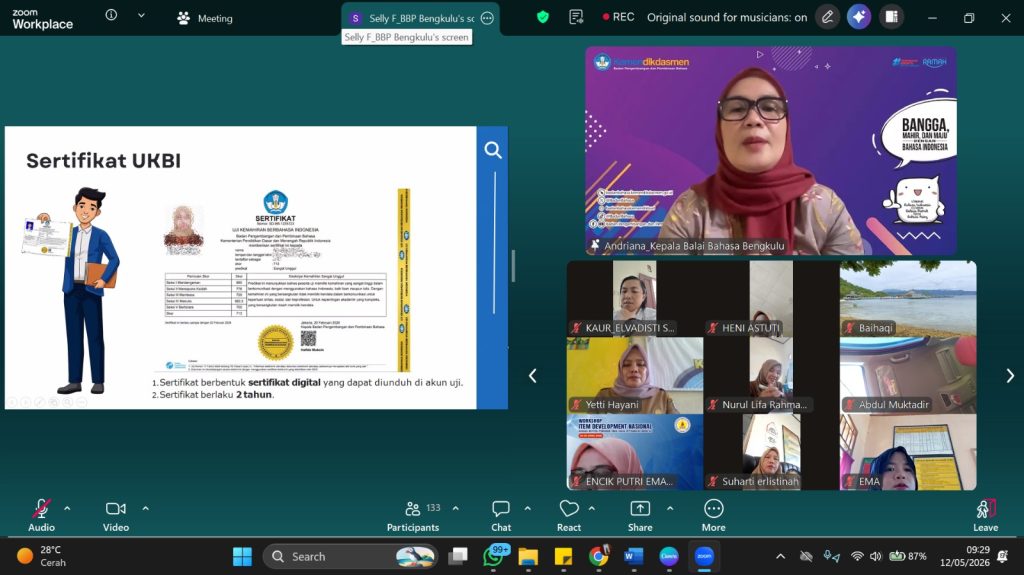
Students of the Master’s Program in English Language Education (MPBIng), Faculty of Teacher Training and Education, Universitas Bengkulu, participated in the Socialization of the Indonesian Language Proficiency Test (UKBI) conducted online on Tuesday, May 12, 2026. The session featured the Head of the Bengkulu Provincial Language Office, Andriana Yohan, S.S., M.A., as the keynote speaker.
The socialization program was attended by MPBIng students along with participants from various study programs at the University of Bengkulu. During the session, Andriana Yohan explained the importance of UKBI as a standardized instrument for measuring Indonesian language proficiency. Participants also received detailed information regarding the test procedures, scoring categories, and the significance of UKBI for academic and professional purposes.

The event was considered highly important for Universitas Bengkulu students, particularly those in the MPBIng program, since UKBI has officially become one of the mandatory requirements for students who wish to graduate with a cum laude distinction. This regulation is stipulated in Rector Regulation Number 2 of 2026, Article 69.
According to the regulation, students seeking a cum laude predicate must possess a valid UKBI certificate with a minimum rank of Level III (UNGGUL) and a score between 578 and 640. In addition, students must fulfill other academic requirements, including completing their studies within the designated study period, obtaining a minimum course grade of B, and having scientific publications in accordance with university regulations.
Through this socialization activity, students are expected to gain a better understanding of the importance of UKBI and prepare themselves to take the test as part of their academic requirements for achieving the highest graduation distinction. The direct involvement of the Head of the Bengkulu Provincial Language Office also provided valuable insights and motivation for students to continuously improve their Indonesian language proficiency in both academic and professional contexts.